


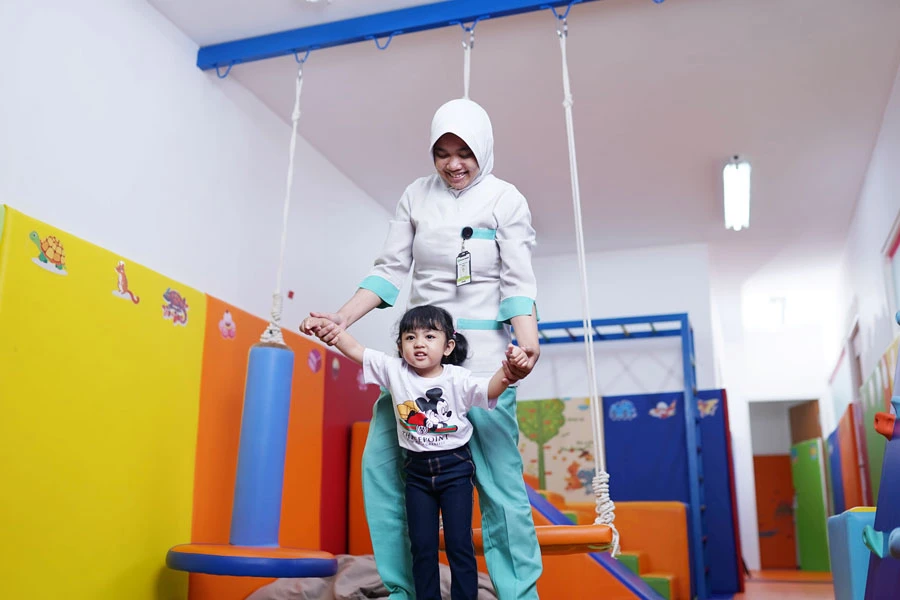
Friends of Persada need to understand the stages of child development. It is intended that you can monitor how your child is growing, whether it is normal, or has certain signs or symptoms that need to be addressed.
Parents must also ensure that their children's growth and development is optimal. Child growth and development not only includes physical changes that occur from infancy to adolescence, but also changes in emotions, personality, behavior, thinking, and speech.
What are the stages of child growth and development? The word growth tends to refer to the quantitative changes seen in an organism's physique, organs and body structure. This growth is seen in size and weight increases, such as height and weight gain.
Whereas development is defined as a progressive sequence of orderly and harmonious changes. "Progressive" signifies that the changes are purposeful, guiding them forward rather than backward.
So, it can be concluded that growth and development is a pattern of change over time that begins at conception and continues throughout the lifespan. Child development looks at several aspects such as biological, social, emotional, and cognitive.
As one of the Pediatric Hospitals in Malang supported by experienced doctors, Persada Hospital would like to share knowledge with Sahabat Persada about the stages of child development.
Let's learn the following stages of child development and visit Persada Hospital Malang to control the growth and development of your beloved baby.
Piaget is a leading expert in the field of cognitive development theory. Piaget sees that development starts from an egocentric orientation, then expands and finally enters the social world.
Piaget divided development into four phases or stages, namely:
A child has a very egocentric nature and is very self-centered. Therefore, the needs in this phase are physical, this function causes the child to quickly master and be equipped with these skills to move on to the next phase.
This phase is divided into two, the para-conceptual phase and the intuitive phase. Pre-conceptual phase (2-4 years). Here the child begins to develop language skills that allow them to communicate and socialize with their small world. Intuitive phase (4-7 years) The child is increasingly able to socialize but he is not yet able to think reciprocally. They pay a lot of attention and imitate the behavior of adults.
The experiences and abilities acquired in the previous phase become solidified. He begins to learn to fit in with his friends and learns to accept opinions that differ from his own.
In this final phase, the child's thinking ability will reach the level of adult thinking ability. The achievement of this ability allows adolescents to enter into a more complex world of education, namely the world of higher education.
Well, those are the stages of child development according to Jean Piaget. In addition to the stages of child growth that you must understand. It is also important to understand what the criteria for child development are.
That growth and development does not mean only physically, but also has other criteria.
Child development criteria are divided into 4 types, namely:
In general, growth is seen in changes in body weight and height. Changes in body size are a visible manifestation of physical growth. Since childhood, these changes change rapidly
The development of control over physical movements through coordinated activities of nerve centers, nerves, and muscles. Some common motor skills in childhood include:
1. Hand skills. Control of the hand, shoulder and wrist muscles improves rapidly during childhood and by the age of 12, the child can almost reach the level of perfection as an adult.
2. Foot skills. After the child is 18 months old, motor development in the legs basically consists of walking skills and the acquisition of leg-related skills such as running, high jumping, sliding, long jumping, climbing, swimming, riding a tricycle or two-wheeled bicycle.
The results of research by cognitive psychologists conclude that the activity of the human cognitive domain has basically been going on since infancy, which is the life span between 0 - 2 years. In a broad sense, cognition is the acquisition, structuring, and use of human knowledge.
Social development means the acquisition of the ability to behave in ways that are socially appropriate. From 2-6 years old, children learn to make social connections and get along with people outside the home environment, especially with children of the same age. They learn to adjust and cooperate in play activities.
These are the characteristics of child development. So, is there a way to optimize children's growth and development? Let's see the following discussion.
According to research, the age of children up to three years is the most important period for child development. Here are some things that you can consider so that your child's growth and development can be optimized:
1. Talk, read, and sing to your child frequently
2. Encourage children to explore and play safely
3. Create a daily routine that involves the child
4. Be warm, compassionate and responsive
5. Be selective in providing television shows
6. Apply discipline in teaching
7. Realize that every child is unique
8. Keep yourself healthy so you can take care of your children
The stages of child development are phases that must be understood by parents in order to realize optimal child development. In addition to fulfilling your child's needs independently. It is important to control your child's growth and development with a pediatrician.
Persada Hospital provides a pediatric polyclinic with services to control the stages of child development. Supported by experienced doctors, the latest technology, and a supportive team, your child's growth and development can be optimized. Visit Persada Hospital's pediatric polyclinic to control your child's growth and development stages.
Check the schedule of Persada Hospital pediatricians to make a consultation visit at the cardiac clinic. Also learn about the latest health information through the Persada Hospital article page. For more information about medical treatments, call the Persada Hospital hotline at 0811-3058-8585.




 Bahasa Indonesia
 English