


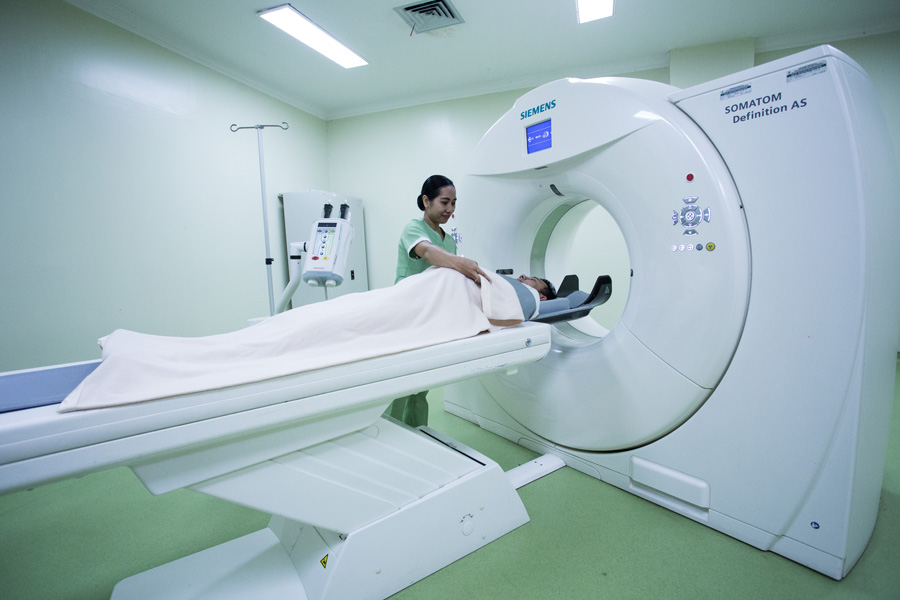
Have you ever heard of the examination of Coronary Heart Disease with CT Scan of the Heart?
Yes, heart examination using CT Scan is an examination that can be done to find out the overall health condition of your heart.
Computerized tomography or CT scan is a diagnostic method capable of taking images of blood vessels, bones, internal organs, and various body structures.
Cardiac CT Scan can diagnose various health problems related to the heart organ. Persada Hospital has a 64 Slice CT Scan that is useful for assisting our medical personnel in diagnosing various heart problems.
Currently, cardiac CT scans are increasingly being performed and have become one of the choices for routine cardiac examinations. CT scan of the heart is chosen because it is non-invasive and can provide information about the anatomical morphological structure of the heart and blood vessels to the maximum.
Examination with a cardiac CT scan can provide data and information in the form of anatomical morphology and provide detailed data on the structure of the heart including coronary blood vessels.
Analysis of cardiac CT scan imaging results is often used today in the form of cardiac morphology assessment, coronary artery calcium score and CT coronary angiography. Calcium score is a technique for assessing calcification in the coronary arteries using numbers.
It has been proven that there is a direct correlation between calcium score and the risk of coronary heart disease (atherosclerosis and plaque formation). Meanwhile, CT coronary angiography can assess the type of plaque and stenosis (narrowing) in the coronary blood vessels.
CT Coronary Angiogram or commonly known as CT scan Angiogram is a CT scan that measures blood flow to the coronary arteries.
In this procedure, the doctor will inject an Iodine-based dye into your veins to make the inside of your blood vessels more visible. A CT scan angiogram is performed on patients who may have coronary heart disease, but the doctor does not yet know what is causing it.
It also helps to determine your potential for heart failure.
CT calcium score is useful for measuring calcium or plaque levels in arteries. Through this examination, we can see whether calcium levels tend to be low, medium, or high.
In this examination, the patient is not injected with any dye. The CT calcium score aims to determine the presence or absence of coronary heart disease. Low calcium levels indicate such a risk.
In general, CT scans have the following benefits for viewing heart conditions:
1. Coronary arteries that supply blood to the heart muscle
2. Heart chambers, heart muscle, and heart valves
3. Pulmonary vein
4. Thoracic (chest) aorta, sometimes can see the abdominal aorta.
5. The sac that encloses the heart (pericardium) 5.
1. Chest pain cases (establishing the diagnosis of coronary heart disease). Includes patients who have chest pain, but normal, non-diagnostic or unclear lab and ECG results.
2. Evaluation of cardiac anatomy, cardiac anomalies/abnormalities, mass/tumor in the heart, blood clot/thrombus
3. Evaluation after bypass grafts and ring insertion
4. Planning for coronary artery bypass grafts, transcatheter/percutaneous heart valve procedures, and cardiac ablation for arrhythmias.
5. Problems with the heart aorta (aortic aneurysm or aortic dissection)
6. Symptoms of cardiac dysfunction with normal, unclear, or inconclusive stress ECG results.
7. Congenital heart disease
8. Problems with the heart valves.
9. Fluid build-up or calcification of the pericardium.
1. Heart rate less than 70 beats per minute, if necessary, beta blockers should be given. Some contraindications to beta blockers include bronchial asthma, AV block, severe hypotension, severe heart failure, and intolerance to beta blockers.
2. Patients are required to fast for four hours before the examination and are allowed to drink water.
3. Avoid drinking coffee, and medications that increase heart rate.
4. Renal function examination (blood ureum/creatinine), as this examination uses contrast fluid injection.
5. The patient is not pregnant.
6. Removing metal-containing objects such as jewelry, glasses, and dentures.
7. Wearing hospital-provided clothing
8. Patients will be asked to take vasodilator drugs, which are drugs that work to dilate blood vessels.
9. For CT scan Angiogram, the patient will be injected with contrast dye. Tell your doctor if you have ever had a reaction from injecting contrast dye for radiation treatment, any medications you are currently taking, and if you have any kidney problems.
Here's the procedure for a CT scan of the heart at the hospital:
1. The nurse asks you to take off your metal clothes and jewelry and gives you a special change of clothes.
2. The nurse measures your height, weight and blood pressure.
3. A nurse takes a blood sample for fat analysis.
4. The radiographer will ask you to lie on your back in a straight line from head to toe (supination). The radiographer may use a harness and pillow to keep you in a fixed and immobile position.
5. The radiographer asks you to raise both arms above your head.
6. The examination table will go into the CT scan machine, while your feet are outside the machine.
7. The doctor places electrodes connected to a machine that records the heart's electrical activity on your chest.
8. During the CT scan, the X-ray beam will move around your body.
9. The CT scan process will take approximately 10 minutes.
10. During a CT scan, the device scans and produces images of your body that can be viewed on a monitor or printed on film. The hospital will also create a 3D (three-dimensional) model of your heart.
Also Read: What is Echocardiography (ECG), its Purpose and Benefits
The results of a cardiac CT scan can only be interpreted by a radiology specialist. The results will help the doctor in charge of the patient to determine the next intervention according to the patient's health condition.
If your heart and blood vessels have no health problems, then the examination results are normal. Through the CT calcium score, this can be seen from the calcium levels in the arteries that get a value of 0.
This means that your chances of having a heart attack in the next few years are low. But if the calcium level is too low, it indicates that you may have a coronary heart disease.
The following are general categories in assessing calcium score on cardiac CT scans:
1. Category 0: No sign of calcification detected.
2. Category 1-10: Very minimal level of calcification, low risk of heart attack.
3. Category 11-100: Mild level of calcification, low to moderate risk of heart attack.
4. Category 101-400: Moderate level of calcification, moderate to high risk of heart attack.
5. Category 401 or above: Severe degree of calcification, high risk of heart attack.
However, if the test results show abnormal results, this may be due to excessively high calcium levels. This may indicate the following:
1. Calcium buildup on the coronary artery wall. One of the signs of atherosclerosis.
2. The higher the heart calcium score, the more severe your condition is.
Abnormal results can also occur due to the following conditions
1. Aneurysms (swelling of blood vessels).
2. Congenital heart disease.
3. Heart valve problems
4. Pericarditis (inflammation of the sac that envelops the heart)
5. Heart tumors
Consult your doctor for lifestyle changes to reduce your risk of heart disease.
Following are the risks of a heart CT scan, please consult your doctor for further explanation of your concerns:
CT scans expose your body to radiation. If done too often, this may increase the risk of cancer. However, you need not worry as CT scans are usually done only occasionally.
If you have an allergy to the contrast dye injected into your body just before the CT scan, inform your doctor immediately. The doctor may do the following:
1. If contrast dye is still required, the doctor will ask you to take antihistamines or steroids before injecting the contrast dye.
2. If you have kidney disease or diabetes, you will be given extra fluids to flush iodine from your body.
3. If you have difficulty breathing during the test, notify the operator immediately.
Here is the right time to get a CT scan of the heart:
1. Friends of Persada experienced complaints such as left chest pain through the back or radiating.
2. You complain of shortness of breath, nausea, vomiting, dizziness, cold sweat, and heartburn. These uncharacteristic symptoms can be a sign of coronary heart disease.
3. Friends of Persada has a family history of heart attacks.
4. Friends of Persada has risk factors such as high blood pressure (hypertension), cholesterol, diabetes, obesity, lack of exercise, smoking, and stress.
5. Friends of Persada will perform cardiac procedures such as ablation for patients with heart rhythm disorders, non-surgical heart valve installation, and detection of congenital heart defects.
Also Read: What is Minimally Invasive Heart Surgery, its Purpose and Risks?
CT scan of the heart is one of the heart examinations that has many benefits and is important. You don't need to worry about the risks of this action, because at Persada Hospital Malang, CT scans of the heart are performed by radiology specialists who collaborate with cardiologists, as well as experienced nurses.
In addition, Friends of Persada can consult about the actions and complaints felt so that the treatment is right on target. Supported by the latest technology, and the experience of health workers, Persada Hospital is ready to handle a variety of heart health problems by collaborating with patients' families for moral support.
Visit Persada Hospital's Cardiac Center for further heart health control before it's too late. Check the schedule of Persada Hospital's cardiologist to make a consultation visit at the cardiac clinic. Also learn the latest health information through Persada Hospital's article page. For more information about medical treatments, contact the Persada Hospital hotline at 0811-3058-8585.





 Bahasa Indonesia
 English